Shivom Era IAS

UPSC,PCS, NET/JRF

Course Details

PSIR Optional – Paper I

Comprehensive UPSC PSIR Optional course covering both papers with concepts, current affairs, answer writing and mentorship.

Back to UPSC PSIR Optional
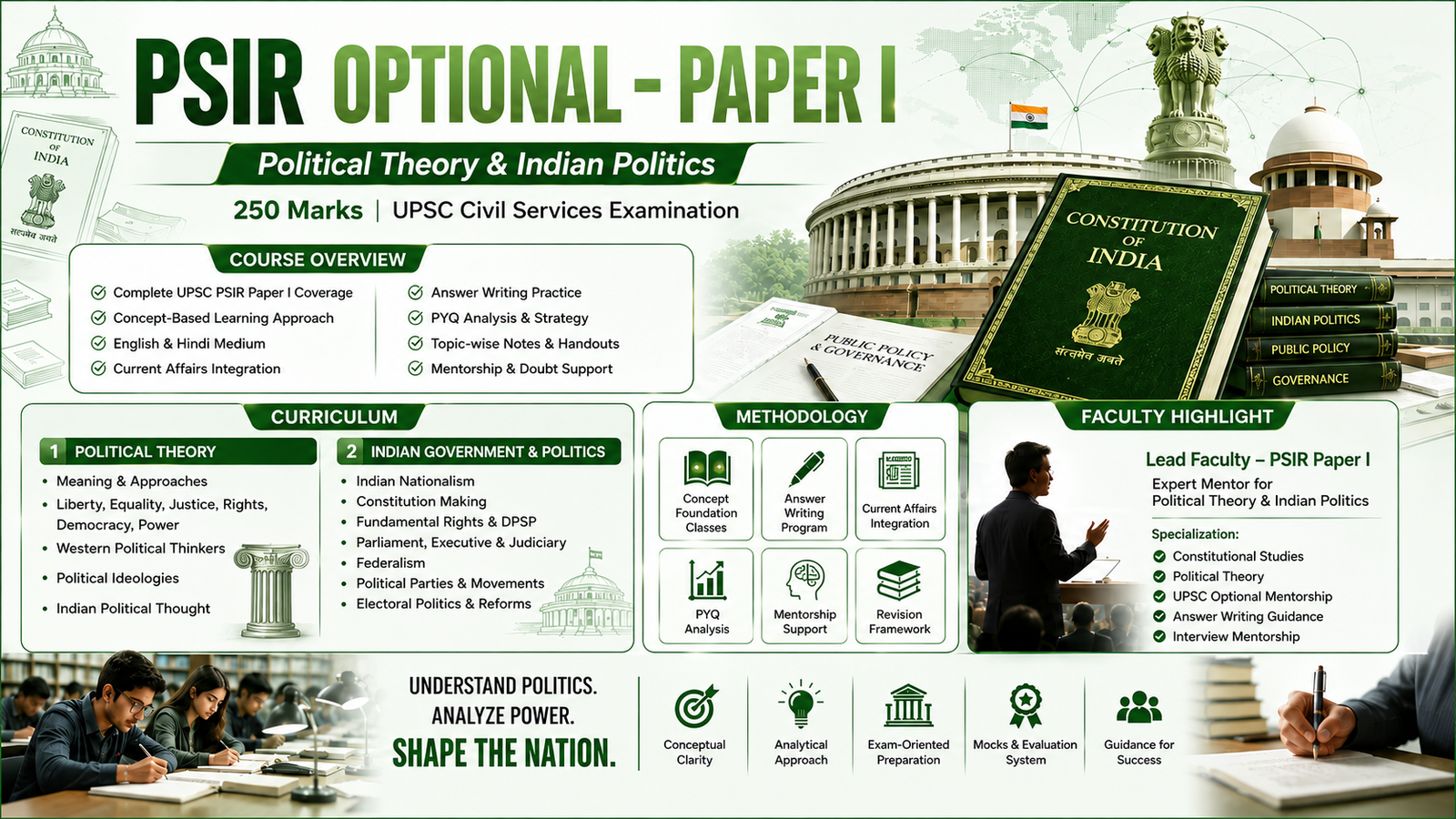
PSIR Optional – Paper I

PSIR Optional Paper I focuses on the foundations of Political Science, Political Theory, Indian Political Thought, Constitutional Development, Governance, and Contemporary Indian Politics. This paper develops conceptual clarity, analytical thinking, and answer-writing skills essential for scoring high marks in the UPSC Civil Services Examination.

The course is designed to help aspirants understand political concepts from both theoretical and practical perspectives while integrating current affairs with static syllabus topics.


Key Highlights


  • Complete UPSC PSIR Paper I Coverage
  • Concept-Based Learning Approach
  • English & Hindi Medium
  • Current Affairs Integration
  • Answer Writing Practice
  • Previous Year Questions Analysis
  • Topic-wise Notes & Handouts
  • Mentorship & Doubt Support

Part A – Political Theory

Module 1: Meaning & Approaches


  • Nature and Scope of Political Science
  • Traditional and Modern Approaches
  • Behavioralism and Post-Behavioralism

Module 2: Political Concepts


  • Liberty
  • Equality
  • Justice
  • Rights
  • Democracy
  • Power

Module 3: Western Political Thought


  • Plato
  • Aristotle
  • Machiavelli
  • Hobbes
  • Locke
  • Rousseau
  • Hegel
  • Karl Marx
  • J.S. Mill
  • Antonio Gramsci

Module 4: Political Ideologies


  • Liberalism
  • Marxism
  • Socialism
  • Fascism
  • Feminism
  • Post-Colonialism

Module 5: Indian Political Thought


  • Mahatma Gandhi
  • Dr. B.R. Ambedkar
  • Jawaharlal Nehru
  • Ram Manohar Lohia
  • Jyotiba Phule
  • Swami Vivekananda
  • Rabindranath Tagore

Part B – Indian Government & Politics

Module 6: Indian Nationalism


  • Various Perspectives
  • Colonial Impact
  • Freedom Movement
  • Partition Legacy

Module 7: Making of the Constitution


  • Constituent Assembly
  • Constitutional Debates

Module 8: Features of the Constitution


  • Preamble
  • Fundamental Rights
  • DPSP
  • Fundamental Duties

Module 9: Organs of Government


  • Parliament
  • Executive
  • Judiciary

Module 10: Federalism


  • Centre-State Relations
  • Cooperative & Competitive Federalism

Module 11: Political Processes


  • Political Parties
  • Coalition Politics
  • Pressure Groups
  • Social Movements

Module 12: Electoral Politics


  • Election Commission
  • Electoral Reforms
  • Voting Behaviour

Lead Faculty – PSIR Paper I

Expert Mentor for Political Theory & Indian Politics


Experience Includes:

  • UPSC Optional Mentorship
  • Constitutional Studies
  • Political Theory Specialization
  • Answer Writing Guidance
  • Interview Mentorship

Faculty Support Team


  • Current Affairs Experts
  • Research Associates
  • Answer Evaluation Team
  • Doubt Resolution Mentors

1. Concept Foundation Classes


Strong focus on building theoretical understanding from basic to advanced levels.


2. Topic-wise Structured Learning


Each topic covered according to UPSC demand and previous year trends.


3. Current Affairs Integration


Constitutional developments, Supreme Court judgments, governance issues, and political developments linked with syllabus topics.


4. Answer Writing Program


  • Daily Practice Questions
  • Weekly Answer Writing
  • Model Answers
  • Personalized Feedback

5. PYQ Analysis


Detailed discussion of previous year UPSC questions.

6. Revision Framework


  • Quick Revision Notes
  • Mind Maps
  • Concept Charts
  • Monthly Revision Sessions
WhatsApp